Showing posts with label Azerbaijan. Show all posts

21 July 2011

Dumbledore going to Baku?

These recent statements by Azerbaijan's Minister of Culture and Tourism have me wondering if the government there is cooking up some kind of Hogwart's magic to prepare the country for Eurovision 2012. Baku is a shell city, and i mean vast tracts of multi-story stone and cement building frames which changed not a bit in the six months i was just living there. It boggles the mind to hear an official claim they are going to be fully prepared for the kind of foreign onslaught Eurovision is sure to bring. Everyone in Baku get your wands ready, because meeting the Minister's goals is going to require one massive wave of transformative power!

One of the more cynical Azeri businessmen i know suggested that the first thing they'll need to do is create a special 'Eurovision visa', because as things now stand, getting a tourist visa for Azerbaijan is both expensive and unpredictable. They'll collect your money, but there's no guarantee you'll actually get the visa. This is going to be especially true for young EU budget travellers, who will have to negotiate via the internet in Azeri to find tourist companies who can provide them with invitations. There are no buses to and from the airport, nothing even remotely like a European hostel to accommodate those who prefer Teva's or other non-heeled footwear, no bus maps and no tourist information centers. But hey, don't worry, be happy! If you do get a visa and find an affordable place to stay, you'll have a great time in Baku. People are friendly and poroskis are cheap. Just remember to be careful if you blog about your experiences: censors rule the day and Eurovision may be a welcome spectacle, but Eurosensibility has the potential to get you deported. Maybe bring a broomstick along, just in case.


18 June 2011

Dance Kavkaz

Out taking photos of people enjoying the Nowruz Bayiram, i came across this dashing young man in the Old City sporting a traditional piece of headwear. Azeris do seem to love items from their traditional cultures, even if today they prefer to embrace knock-off's of modern, upscale chic. i've had a couple of souvenir sellers try to get me to buy one of these, but my hunch that they were not made for women turns out to be correct. Always eager to assure me that doesn't matter, they are suddenly less immune to gender expectations if i do something radical like accidentally flash a pack of cigs or add to confirmation of my single status that i'm not at all interested in finding a husband, Azeri or otherwise. Yet i digress.

Last week one of my students showed me a fantastic video he'd taken of dancers at a wedding (on his blackberry! god, my life is so technologically deprived) but since the file was far too big to email, i started checking out what youtube has to offer in the way of Lezgi dance. This ended up being a relatively long indulgence, as i found the array of commentary threads more interesting than the dance clips, themselves. Many of the comments are in Russian, Azeri and who knows what other languages (Armenian? transliterated Georgian?) but here are a couple examples, just to give my readers an idea of where/how dance and national identities mix (or don't) in regional minds..
Actually Lezginka is a national dance of many people from the Caucasus. It's name comes from the Lezgin people; nevertheless, Chechens, Lezghins, Ossetians, Circassians, Karachays, Balkars, Abkhazians, Kabardins, Ingush, Georgians, Ingilos, Azerbaijanis, Iranian Azerbaijan the Russian Kuban and Terek Cossacks and the various ethnicities of Dagestan have their own versions of Lezginka.

Another comment:

I'm sorry to disappoint all those thinking it's Dagestani dance, costumes and music. They were altered (for the worse) with significant Russified elements, which true Dagestani dance, constumes and music do NOT have. Dagestan has a very distinct from Russia culture. This "concert" was obvioulsy targeting some Russian Russians and foreigners liking/familiar with Russian culture. In sum, this circus is misrepresenting of truly Dagestani culture (dance constumes, music). What a circus!

This time, snippets from a discussion thread:
(1) This is not sukashvili, I have most of sukashvili's DVDs. This is from Dagestan. Of course georgians as usual make every good thing that comes out of caucas look as if it was theirs. Sukashvili is an amazing ensemble too but this one for sure isn't sukashvili. Dagistanis do it well Georgians take the credit for.

(2) what? this is not Georgian dance? are you out of your mind? haha this is an outrage man somebody on the youtube must make policy and stop graud like this it is fuckin desgusting..... change the title (its real name is Parikaoba) or I am reporting this video and reporting your profile both

(3) This is not georgian dance. It is chechen lezginka. Shame on you!
At this point, i don't know which dance truly and unadulteratedly represents which culture; even if i wanted to put the time in to sort out the differences in costumes (easiest) and associated music (doable but time-consuming), being able to distinguish dance styles, which many seem to believe have infinite overlap, is quite honestly beyond my terpsichorean capabilities. Originally planning to call this post 'Lesginka', i humbly bow to my own confusion, only able to say for sure that the following clips and links are from the Caucasus region.

This one has a great opening, with the knife dancing and is an 'official' dance company, so i want to trust that the cultural representation is accurate (trust is all i've got here, sorry). Check this out to seem some knife throwing.


Here we've got men in the sheepskin hats, filmed at a wedding, which captures a certain in situ atmosphere.


Lastly, i just love this frenetic video from southern Azerbaijan, which focuses a bit more on the musicians and is called Shalaxo.


In a couple weeks i'll have left this country, so trying my best to introduce my far flung readership to some of the more interesting and unique features of Azerbaijan. Unfortunately, i've hardly been able to get out of Baku (6 day work weeks have that effect) but i follow hints from people i meet as much as possible... this whole dance world sent my into a spin. Hope you enjoy!

04 June 2011

Sepals to Salvation: Springtime in Baku

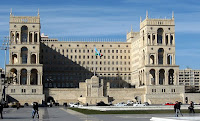
Yesterday i had to pass by Government House, one of Baku's more imposing yet impressive public structures, and couldn't avoid noticing that preparations are underway for a major public event. Trivia alert: 'Designed by architects L. Rudnev and V. Munz, it was completed in 1952. Like many other post-war buildings in Baku, German prisoners took part in its construction.' The crenelated towers are so very archeo-Azeri, but my favorite features of this building are its Soviet era insignias. You can't tell me this isn't historically rich, almost reverential, in its design and probably encapsulates the core nature of the relationship between Kremlin and this combustible fuels Wunderland.
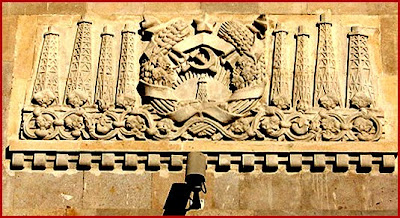
Back to what were either viewing stands or a stage being assembled, i remembered that there's a public holiday 15 June (nationalist section of my brain always slow on the uptake), obviously one in which high-ranking officials will take part. Proceeded to ask students in my afternoon classes what National Salvation Day (once we remember, we really remember) commemorates, but not one could tell me (impromptu homework assignment!) and thus, off to Google i went.

On one of former President Heydar Aliyev's fansites - oddly authored by a Mexican, primary narrative entitled He Brought Salvation to His People - i see the date 15 June and immediately the pieces fall into place:
En mayo-junio del año 1993, cuando en relación a la agudización extrema del crisis de go­bier­no, en el país surgió un pe­lig­ro del comienzo de la guerra civil y la pérdida de la independencia, el pueblo azerbayáno se levantó y exi­gió de subir a Heydar Aliyev al poder. Los dirigentes de entonces se vieron obligados a invitar oficialmente a Heydar Aliyev a Bakú. El 15 de junio del año 1993 Heydar Aliyev fue elegido el presidente del Soviet Supremo de Azerbayán.
In a nutshell: Aliyev saved the country from potential civil war, reoccupation by Russia, loss of even more territory to Armenia, overall disintegration into ethnic and economic chaos. The BBC provides this timeline, starting with the Turkmanchay treaty of 1828 and continuing to Ilham Aliyev's (son of Heydar) New Azerbaijan Party's stunning electoral victory in 2010 (my tongue is stuck in my cheek but hopefully yours isn't). More detailed background on post-Soviet history is available here. Heydar had run the Autonomous Soviet Republic of Azerbaijan in the final years of the CCCP and headed its security forces following independence. He was a stalwart KGB figure and i've yet to meet an Azeri who doesn't credit him with keeping the country together and setting it on 'the right road for improvement in national character', to quote one of my students. As a major player in the world's oil and gas industry, it would probably be hypocritical for anyone who's not off the grid, totally car free, etc. to criticize him for using whatever tactics were employed to create stability. Let's just leave it that for now.

The flat granite surfaces of Baku's public works are everywhere inscribed with Heydar Aliyev's 'wise admonitions', more or less what one would expect from any political leader of significant - nearly mythic - stature. As a foreigner, they offer great speculative insight into the country's ideals and self-image, its values and veneer: what could be, compared to what's been. Here's a small, provocative selection; readers of this blog are free to draw your own conclusions.

Patriotism is an inner feeling of the person. If he is missing that, he is immoral.

To make a hero of the thief and bribe taker is to betray the country.

Great intellect is not common. A scientist, a poet, a composer, an artist, a writer, an actor - all these are rare, gifted people.

One cannot relate great policy to tiny senses and little profits.

To conduct peace negotiations from a firm base one must possess a strong army.

It is necessary that the history should be accepted as it is in reality, realized and valued.

If leaders oppress a people with a great national spirit, this is the greatest tragedy for a nation.


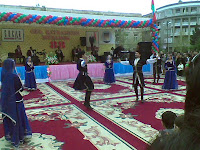
Last month, the country combined celebration of its Flower Holiday with that of the Aliyev's birthday on 10 May (he died in 2003). The week of creative floral works was kicked off by the national oil company, SOCAR, providing a day of cultural activities and performances in one park (caught off guard, i had to resort to poor resolution phone camera), while major floral art was being prepared over the course of the week in another (Heydar Aliyev Park, naturally) for the big presidential commemoration on May 10. Here are a few photos. The flower sculptures are really lovely - so lovely, in fact, that they were protected by a small army of police and the line to gain entry into the park was longer than i was ever able to stand in it. Still, scouting round the periphery fencing was worth it. i'm told that on 15 June there will be a grand military parade, so i'll try to do better next week, though rifles and RPGs are not nearly as attractive as butterflies and fairytale characters.
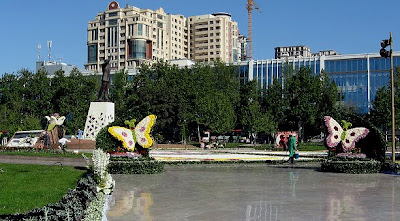


Here's the main stage, with Heydar Aliyev presented in grande floral design. The portrait isn't blurry; what your seeing is the overlapping sepal effect typical of flower art on this scale (do i sound like an expert floral critic? Ha!!). Baku is full of billboards sporting Aliyev's photo, and i must say i like what i saw here better. People told me this whole spectacle - flowers, evening concert, requisite security details - cost the government upwards of 60 million manats, which is no small sum. Already too warm for icing to hold its shape, why not let them eat flowers?!

01 June 2011

Lost in Transliteration

One of my students recently asked about the origins of 'OK' and whether it had started out as an actual word before becoming the easily-texted acronym used by speakers and non-speakers of English, alike. The answer turns out to be much more americana than i would have guessed. It started with an 1838-39 New England slang fad which was then appropriated by the re-election campaign of the 8th US president, Martin van Buren, known by supporters as 'Old Kinderhook,' a man who supported forced removal of the Cherokee’s in spite of having written ‘The government should not be guided by Temporary Excitement, but by Sober Second Thought.’ According to etymology online:
Van Buren lost [the election], the word stuck, in part because it filled a need for a quick way to write an approval on a document, bill, etc. The noun is first attested 1841; the verb 1888. Spelled out as okeh, 1919, by Woodrow Wilson, on assumption that it represented Choctaw okeh "it is so" (a theory which lacks historical documentation); this was ousted quickly by okay after the appearance of that form in 1929. Okey-doke is student slang first attested 1932.
Woodrow Wilson probably needed an innocuous term like 'okeh' after getting re-elected in 1916 under the banner He Kept Us Out of War and then asking the US Congress in 1917 for a declaration of war. 'The world must be made safe for democracy.' Indeed, to this day the inhabitant of the Oval Office believes 'it is so'. Another source adds Teddy Roosevelt to the presidential mix:
"O.K." (aka "okay") originated with US President Teddy Roosevelt, when his staff would inquire to him "How's everything today?", he would reply "Just like at Old Kinderhook." Old Kinderhook was a camp that he had attended during his childhood with great memories. [ed. Both Van Buren and Roosevelt came from the same area in New York State.]
while yet a third source tacks on this bit of proletarian trivia: 'Greek immigrants to America who returned home early 20c. having picked up U.S. speech mannerisms were known in Greece as okay-boys.' One small piece of slang, one expansive foray into American history. At least we can say this is one word from their rebel colonies that the Brits don't seem to have had much trouble assimilating into their more pristine anglais.

In college, i had a Medieval Chinese History professor who was passionate about the way Chinese philosophical history was embedded in the stroke patterns of the language's characters. The concept of orthography as a carrier of cultural development was at that time somewhat new to me, but as a would be writer and avid (painfully verbose) talker, i've since been attempting to do a respectable dilettante's job of catching up, academically. There are so many ways to communicate and absorb ideas - i often perceive concepts as manifestations of Flatland-like, geometrical relationships; some people understand things clearly through color, or sound - if language is going to convey interpretive, cultural meaning and to assign values to things both objectified and abstract, then the words we use to construct them need to consist of more than just phoneme tags. CUL8R is cute and all - i certainly enjoy letter-digit symbology - but it's important to me that people remember this is symbology, that the meaning is based on actual words which have linguistic histories, that those histories are far from random even if the phonetics are not.

Living in Azerbaijan these past few months, i've constantly found myself caught in a tug of war between orthography and meaning. The Azeri language, a member of the Turkik (Altaic) language family, is a fascinating amalgam of tongues that together reflect the full gamut of historical experience: invasion, conquest, expansion, integration - back and forth, on and on - such that we find today significant overlap with Turkish (Turks insist they can speak and understand Azeri perfectly; Azeris insist it's the other way around; neither are completely at ease using the term Azeri Turk as a modern identitfier for the people now called Azerbaijani); there are French words acquired through Russian, Russian acquired through years of CCCP integration (and probably, cyrillization of the Azeri script), Arabic words that came through Persian and some modern Farsi appropriations, as well (Azeris tell me these words are Turkish, but then where did the original Muslim-conquered Turks get them from?). Add to this the variety of local tribal idioms (see Dance Kavkaz) and you get a modern language that contains about 1500 years' worth of linguistic influences. Is it any wonder the national lexicographers have apparently taken the attitude that if they spell it Azeri, they make it Azeri? (Anyone reading this who takes offense, i'd be happy to discuss it with you over a nice biznez lunc, will even bring my ofis manejar along as backup translator.)

There is an acute difference between making language fun and making language funny. For me personally, orthography - like emoticon/texting symbology - mostly falls into the latter category, though sometimes i see transliterations that make my inner indo-europeanite cringe. Take, for example, this theatre poster for an Azeri adaptation of Shakespeare's Timon of Athens.

According to wikipedia, the Old German is Wilhelm and Old Norse, Vilhjálmr, bringing us as close to the Azeri spelling as Anglo-Norman Williame, but for someone who wrote with the sharpest of pens, this transliteration of Shakespeare strikes me as - i don't know, silly, i guess. Way too far afield. However, the thing about proper names is that if you want people to say them more or less correctly in their own language, you've got to make allowances for extremely different letterings. Sekspir. Fair enough.... whatever.

Next up, the sign over a home furnishings store. Aksesuarlari? Hungarian speakers will immediately relate to the ler/lar plural form, which leaves us with aksesuar as the base noun. From the French accessoir, originating from Latin accessōrius: moving to adapt, towards accepting subordination, etc. etc. starting with the initial prefix, ac-. i really don't want to come across as being totally anal about word derivations, but as any fashion queens knows, it's all about making the little pieces come together. For Azeris out to accessorize their home furnishings, what significance could this word possibly have? i'm sure they got it from the Russians, but given the different alphabet, how would a non-russophile know that? The word thus takes on an objectified meaning based on - well, nothing beyond what's available in the showroom. Put this together with mebel, akin to Spanish mueble, and we immediately sense the profundity of res mobilis, res vilis.

Lastly and my personal favorite: kseroks. Any guesses? Having lived outside the US for nearly a decade now, i rarely hear this word used anymore and once i learned what it meant, have kept my eyes peeled for an actual Xerox-made copy machine. Sightings? Zero. Assuming the vast majority of Azeris don't know that Xerox was the original photocopy king of kings, i'm left wondering what they think about the source of this word for 'photocopy'. KƏNIN would have made a lot more sense, if we're thinking along the lines of Hoovering, Ajaxing and having kleenex on hand for those sentimental Kodak moments.

For me, this is something of a double whammy: i've always thought it absurd to use a machine maker's name for the thing the machine produces and now i've got to use the name with a spelling that has no relation to it, whatsoever. The orthography here is totally screwing with the etymology and i just don't like it, not one bit.

There's an Australian aboriginal character in one of Herzog's films who confesses that the reason he stopped speaking was because the slow genocide of his tribe left him with no one who spoke his language. Honestly, there are moments when i feel that way, a slow descent into a globalized transliteratory and mis-translational hell. In Hungary, hello is now part of the everyday language, which sounds graciously anglophilic until you realize they use it at the end of a conversation, not the beginning. i'll never get used to that, anymore than i will looking for a place to kseroks some documents. i'm all for diversity and mashing things up, world music and intergallactic web servers, etc. etc. but the words still have to mean something! Otherwise, our thoughts become temporally exclusive and watered down across cultural boundaries to the point where we're all negating our identities in order to communicate basically nothing. What would Homer say? Okay? OK? Okeh?

02 May 2011

We're all powerless here, except for the prez

The first time it happened was about a week after i'd moved into my flat, about 2-1/2 weeks after arriving in Baku. A not too terribly cold night, i'd taken a rambling, roundabout route home, soaking up the sights, sounds and odors of residential night life. When i got to my own street, i suddenly realized it was VERY dark; not dark as in there's no moonlight, but rather urban darkness, as in there's no electricity. My local butcher was conducting business by candlelight, other shops were using kerosene lanterns... clearly, this was not an unusual occurrence. Up four slights of stairs in total darkness - spooky but adrenalizing - when i entered the flat and looked out the balcony window, all i could do was laugh. Business owners and bars on my little side street were depending on paraffin stocks, but in the zone of City Hall, no voltage is spared to maintain Baku's image as a beacon of light shining on the shores of the Caspian's fossil fuel fortune.

i can't say that i hadn't been warned Azerbaijan has 'utility issues' and for the next few weeks, Wednesdays were my neighborhood power outage day. Other people i know here have either much less regularity or normalized daily shutdowns (no water from 9:00-17:00 every day of the week), so i was actually feeling somewhat blessed by the predictability of what was, overall, a relatively benign situation. However, i also realized on that first evening that loss of power means loss of water, because the water pumps installed to solve the low water pressure problem in apartment buildings here run on electricity. Without the pump, not a drop to drink. While that first night was kind of third world romantic-like, with the candles, 3 layers of clothing and Book I of The Iliad ('He sat himself down away from the ships with a face as dark as night, and his silver bow rang death as he shot his arrow in the midst of them'), being able to turn on the gas stove to make coffee is a moot amenity when there's no water to fill the pot. By the time i'd gotten it together to go out and buy some bottled water, the power had been restored.

The other day, i came home in the afternoon to have a job interview on skype and of course, even though it was Thursday, there wasn't any electricity. Total karmic no go zone. This time it was because Baku Electric had turned the switch off - that's what i get for trusting a new and now ex office manager with both my money and functionality. No warning notice - i guess they figure that people already know they haven't paid, so why bother to waste paper reminding them? Two days without water and electric, working 12-hour stints, is not really conducive to achieving my low stress objectives. My school was on the second day of phone lines being down, hence no internet access... i've omitted here my mid-winter crisis of going 10 days without water when the electrical workers refitting my building cut the line to my pump, but you get the general picture. The concept of having control over one's basic needs gets rather abstract; people have private cisterns and tanks, keep lots of batteries and candles on hand, but there are neither sympathetic comraderies nor complaints. This is just how life is, we are all at the mercy of inept, faceless forces and errant urban planning.

On the bright side, last month i found this notice stuck in the door, loosely translated for me as the president of the republic has decided to be gracious and relieve everyone from having to pay the water bill for a month. If an azeri speaker happens to read this post and is willing to give a more exact translation, have at it. i've always assumed there had to be some benefit(s) to living in a benevolent big D, and i guess this is one of them. An omnipotent leader can mimic the IMF and just make all our debts go away. Wow! When has a US prez ever done that for the working man? Not in my lifetime. It's comforting to know that at least one person is in control of the utility situation, with no Enron equivalents to muck things up. Maybe next month, we'll get free wifi? With all the moaning going on over royalty these days, i think people are missing the bigger picture. There's something to be said for having a national sugar daddy, someone with the means to just wash all our power struggles away.

26 April 2011

Health, Beauty and further proof that wearing a watch is a bad idea

Nothing quite so profoundly reminds me what it means to be American like getting sick. Last week i got the flu and all my cultural conditioning immediately kicked in: calling in sick is a sign of weakness and indicates lack of commitment to one's job, going to a doctor is only necessary as a last resort, the need to rest is a euphemism for the desire to be lazy. Logically, i know none of these attitudes can survive much scrutiny; however, cultural responses to unexpected situations - i was going to say 'stressful situations', but only an American would classify illness as a form of stress - are not based on logic, but rather on normative behavior.

In the US - especially for those without health insurance - the norm is to work until you drop and as soon as you can stand up again, get back to work. It's no small coincidence that Americans are so inclined to try self-help remedies, women moreso than men. The principle difference between us and Europeans is that much of the alternative/complimentary medicine in Europe is practiced by doctors, whereas in America, we have learned to avoid doctor visits as much as possible and do our best treating ourselves. Over a decade ago, i contracted lyme disease and believe me when i say that i did a lot more work than any of the doctors i went to in figuring out how to recover and then manage this disease. 'It takes a lot of work to get well' fits very nicely with the entire cultural ethos (physical therapy is obviously an exception).

At any rate, while i was being a lazy bum, staying out of the rain and (intense Caspian) wind, drinking a catatonia-inducing quantity of Theraflu or whatever its Russian equivalents are called, i did manage to save myself the expense of going back to a hair salon by covering up those gray roots in the comfort of my own home. This is not to say that i regret having experienced the pleasures of an Azeri salon - au contraire! To spend an afternoon in the midst of so many black-haired beauties carrying out their feminine mandates was precisely the sort of perspicuous adventure any armchair anthropologist would crave.

It's probably safe to say that in a place where the bars and tea houses are predominantly exclusive to males, upscale beauty salons become a sort of female clubhouse. There seemed to be a number of women there just to gossip, drink tea and compare accessories. Smokers came and went through the back door. The only way to distinguish workers from customers was in the footwear, with employees sporting every color of plastic slipper or epsadrillo knock-off imaginable. Instead of music, a muted tv screen was set to a Turkish music video channel: sexy girls in sexy clothes, being drooled over by sexy, lustful men. The whole atmosphere felt almost conspiratorial.

While i was in 'the chair', a would-be Avon lady stood in front of me and methodically went through her entire bag of cheap, glitzy hair pins and jewelry. It didn't seem to matter to her that i wasn't going to buy anything; in a country of high underemployment, not making a sale here was just as good a way to spend the day as not making a sale somewhere else. Anyway, each hair stylist has 3-4 assistants who do lots of mindless tasks, such as taking the place of hair clips, (used in western salons) by holding the sections of hair that aren't being cut or colored, so there was a little mob around me who were happy to ooh and ahh over the contents of her various satchels.

Being a non-Azeri client, i was an item of obvious interest and practically everyone who worked there had to come over and get the low down on what exactly was being done to my voluminous locks. Cups of tea came, cooled and were replaced by new, hot ones. There were several discussions about ideal cuts and styles, followed by repeated disbelief that i only wanted a trim, as if i was insulting their sense of feminine propriety. My hair was dried simultaneously by three different girls while their mentor looked on, giving tips on pulling and fluffing. Far too much fussing for me, but i had to assure them all over and over that yes, the color was good and yes, the cut was what i wanted and yes, i would come back again. When i was finally finished and waiting to pay, in came a woman with a crate of kiwis to sell, which seemed like the perfect finale for this little afternoon comedy. Surprisingly, tips are not de rigueur here, which was fine since i was already paying way more than i'd expected. But no complaints. They gave me the full treatment, as it were, and it was definitely worth the experience.

Clearly, health and beauty are complex cultural realms, especially across national divides. Nonetheless, it was beyond shocking to read that wearing a watch - which has always seemed to me such an internationally accepted form of accessorizing that it doesn't even count as noteworthy - was responsible for no small number of men being renditioned to Guantanamo. Evidently someone(s) at al-Qaeda decided Casios were the perfect gift for their recruits; hardly as classy as a Rolex, but Casios do come with all the practical features a materially deprived, mountain-based terrorist needs: shock resistance, altimeter, solar power and a multi-functional alarm (one imagines that working for Sheikh bin Laden, effective management of alarms would be high on the list of priority skills). The lesson here is that sometimes it might make sense to look a gift horse in the mouth and just depend on the sun and stars to set up your attack plan, as warriors did in the time of Xerxes. Undone by a watch? Well, for a religious fundamentalist it's probably more palatable than being undone by a beautiful woman. But let's not tell the ladies here that, we wouldn't want to spoil whatever romantic fantasies may lurk in the minds of those yearning for eternal beauty, however contrived.

12 April 2011

Strewn relics, crumbling walls

Years ago, my friend Rachel - who, unlike myself, is a real photographer with excellent eyesight, ergo can take pictures that are actually in focus - produced a group of photographs which came to be fondly known as the dead animal series. These images included carcasses of roadkill, bones from dessicated desert creatures and other remnants of animal life in varying stages of decay. What i always found profound about them was the window each photo opened into my imagination of the animal's demise: how it collapsed to the ground or crawled off into the woods to die, the invasion of detritivores, the final stretching or contraction of muscles. Then the fast forward, back of the eyelids flickering that brought a body through its loss of flesh to the bare, clean-washed skeleton seen in the photo.

The other day i went to out to the Absheron peninsula, which brought Rachel's photos to mind in that so much of what one sees there seems to be the decaying relics of the Soviet era and oil industry, what still remains from the heyday of 'peace, bread and work'. As Lenin famously remarked, "fascism is capitalism in decay," and apparently he and his political descendants were intent on proving this to be true. What is perhaps most interesting is the extent to which life simply goes on with the rusty equipment, decaying walls and shaky gas lines. It's not the same as walking through an exclusion zone, yet there is a grimy, cynical sadness about this environment which i find oddly captivating.

Rusted out, often abandoned pump jacks pop up from the flatlands in every direction. It's hard to imagine how anyone could psychologically acclimate to living in a virtual forest of these grinding praying manthises: it's not the mechanical nature of them that disturbs the senses so much as the hardened pools of tar at their bases, the incredible proximity to people's homes, the utterly intense indifference conveyed by repetitive up and down motion or the immobility of lengthy disuse. This detritus from the oil industry works as an oxymoronic magnet, something so shocking at this scale that i simultaneously feel a deep revulsion and a morbid desire to see how disgusting it can actually get. Petroleum is a dirty industry, we all know this to be true. Seeing this side of it - a place where people feel proud of their country's contribution to the global petrol market and are inured to the quality of life costs because that's simply how it needs to be done - i'm left wondering if it's really fair to sneer at all the massive SUVs clogging the streets of Baku. That is to say, having already irreparably trashed the land they live on, does it make sense to suddenly care about energy conservation and auto efficiency?


Outside the town of Suvelen, i encountered a cemetery that overlooks a large seaside refinery and has clearly changed hands from red star era Russian Orthodox to a glittery, we-wish-this-were-Shiraz Shia Islam. At the top of the hill are the weathered Russian gravesites. Again, that feeling of decay and abandonment, of a place which once held meaning being left to the elements. Not sorrowful, but lost. Small monuments to those who came before, intact out of respect or indifference - who can say? They stand as relics of a time people clearly want to put behind them. Fenced and overgrown, dotted by the occasional, inert pump jack (yes, in the middle of a cemetery, when it comes to oil no ground is that sacred), the only flowers at these graves are those growing out of the earth, eventually sure to envelop them. Walls fall, fences collapse. The decay of their relics does not, per force, imply the decay of the people.

30 March 2011

Fire on the Mountain

'Out of the frying pan, into the fire' only partly characterizes my recent relocation, since prior to getting fully settled in this land of flame and contradictions, i was proverbially stewing in a very, very, VERY slow-cooking dutch oven.  The mind works in mysterious ways, or sometimes doesn't function well at all.  A brief moment of epiphany in which the depth and effect of stress on my being came to light, then avenues appeared out of that abyss until suddenly - wham bam thank you ma'am - a flash of sentence-forming adrenalin and here i am opening the link to my blog again, after a much too long hiatus.  My new place of residence is the city of Baku, the largest port on the Caspian Sea and yet another place i never in a million guesses would have placed myself in for more than a week or two.  C'est la vie, ou peut-etre la mode... i'm sure the Tao is actively at work here; as a committed atheist, i'm always eager to point out that (unlike many religious zealots) i strongly believe in The Future, that even entropy is systematic in its inclusiveness: everything has a niche, however small and inconsequential in the face of big bangs, revolutions, or what have you.

So, welcome back to my frenzied search for meaning in an era in which most people are consumed with the search for money (or look towards money as the fountain that dispenses meaning), or for someplace safe, for people who are friends outside the friend-fantasy land of facebook, or just for a few minutes of real peace and quietude.  What is most transitory is often of utmost immediate importance; to recognize and roll with this at times feels like the only thread of continuity in my grasp, though i doubt it gives my existence much value, least of all to myself.  To be perfectly blunt and admittedly egomaniacal, i simply don't want to accept that this is all that defines me.  The niche should be broader, the channel deeper, the dance, as it were, much more multi-rhythmic. Everyone should have a mission, and it seems that after half a century of wandering around the planet, this is what mine has either come down to or evolved into, the jury is still out on that point.

Azerbaijan has an interesting history, yet another land that's been partitioned again and again over the centuries, such that the terms 'nation' and 'country' are qualified in just about every conversation and shift depending on the time period being referenced.  It also plays a pivotal role in the world's oil and gas distribution networks and is truly a land of eternal fire.  The recent holiday of Nowruz has its roots here, and having visited a couple of natural gas seeps, i am seeing the roots of Zoroastrianism in a whole new light (no pun intended).  The top photo was taken at Atesgah, the Temple of Fire on the Absheron peninsula whose foundations date back to at least the first millenium AD and i'm guessing even earlier.  Below are a couple shots from Yanar Dag (Fire Mountain), up in the hills above Baku, a place which acquired its moniker in much more recent times, after someone tossed a cigarette onto the ground at a spot where natural gas just happened to be leaking out.  Coming from a place (Hungary) where gas prices are exorbitant and supplies somewhat insecure, it requires a total change in attitude to not freak out seeing a local gas supply burned up in the interests of second rate tourism.


Blogspot has changed its design features during my absence so it's going to be a bit touch and go as i acclimate to the new formatting constraints. It feels good to be back here though - no question there are LOTS of things to write about, nukes and the Middle East are, as ever, at the top of my list!  Yet there aren't many english blogs coming out of Azerbaijan so i'm looking forward to exploring this novel facet of my experiential universe as well, getting another view of this place out there into the virtual world.  Please bear with me as i relocate my lexical limbs... caught in slow motion in a dash for the door...